

All Good Things...
Pulling out all the stops - and bringing back Q! - for one last trip into the unknown

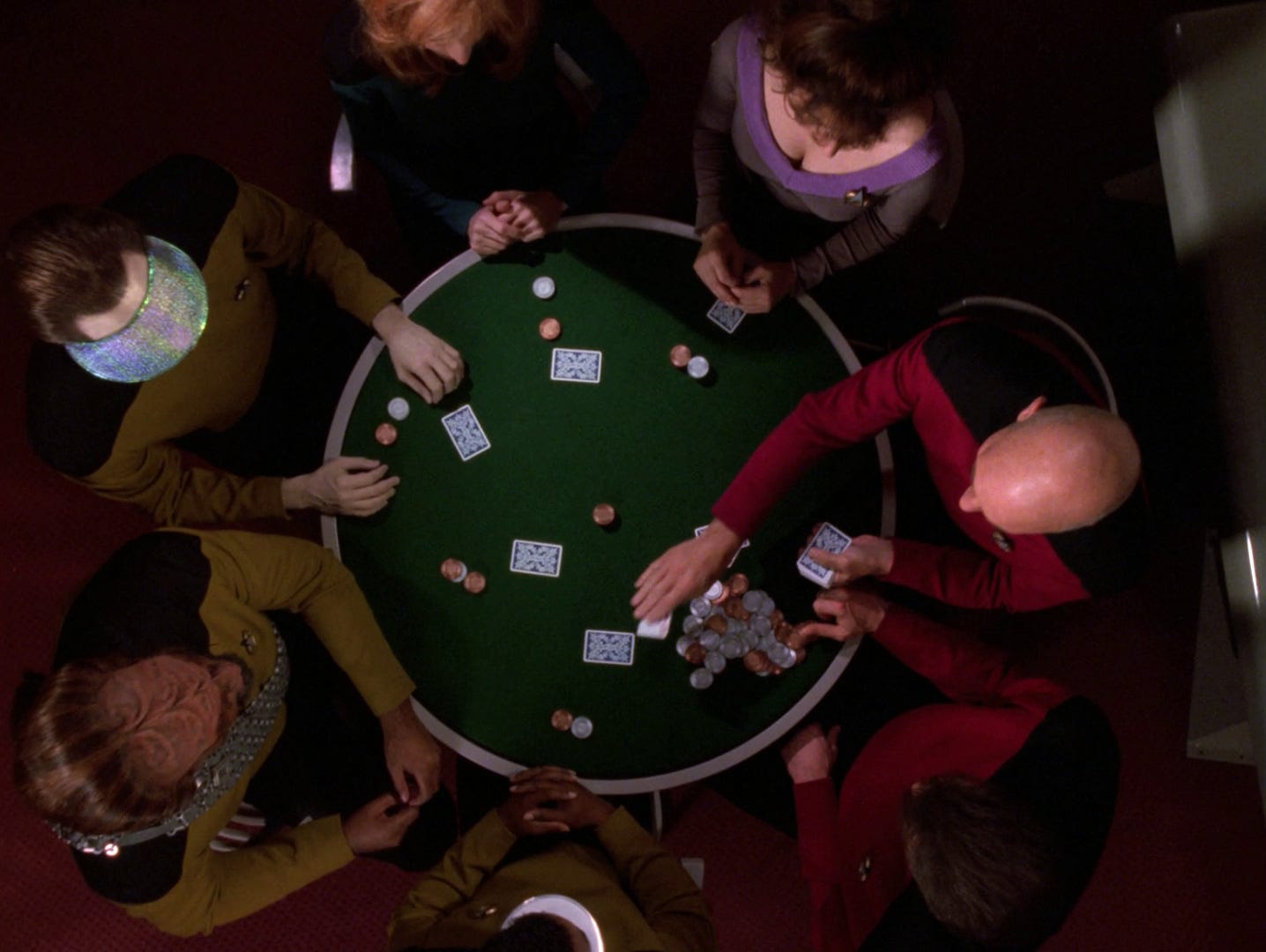
Worf and Troi are prevented from kissing by a time-travelling Captain Picard who arrives just in time to stop them from sealing the deal (much to the relief of my wife!). Soon, we’re jumping around with Picard between his vineyard in the future, his first days on the Enterprise-D, and a few more temporal destinations besides! Before long, we hook up with Q, who takes Picard back to the courtroom in “Encounter at Farpoint”, and warns Picard that he is responsible for destroying the human race. Drama! Adventure! Painfully transparent fan service! This one has it all.
Words
This isn’t just one of the greatest season-enders, it’s a masterclass in tying up a television show. Not only did they pack in every fan-pleasing guest star imaginable (more on this below), but they crank the ‘shipping’ up to 11 to set up future relationships that may not make the best sense, but they’re certainly fan-pleasing. They put LaForge together with Leah Brahms for goodness sake, in total contradistinction to everything that arc had already established - and they gave the Enterprise a cloaking device, Treaty of Algeron be damned!
But this screenplay did not come easily, and the draft was only finalised on 10th March 1994, the day before filming began. They shot it over 17 days, an overrun of three days from the usual week per episode (since this counts as two episodes, despite being screened as a movie length special - just like “Encounter at Farpoint”). It was written by Brannon Braga and Ronald D. Moore - the first time they shared the screenplay credit. Concurrently, they were already working on the screenplay for Star Trek Generations - which apparently caused them to get mixed up between the two stories!
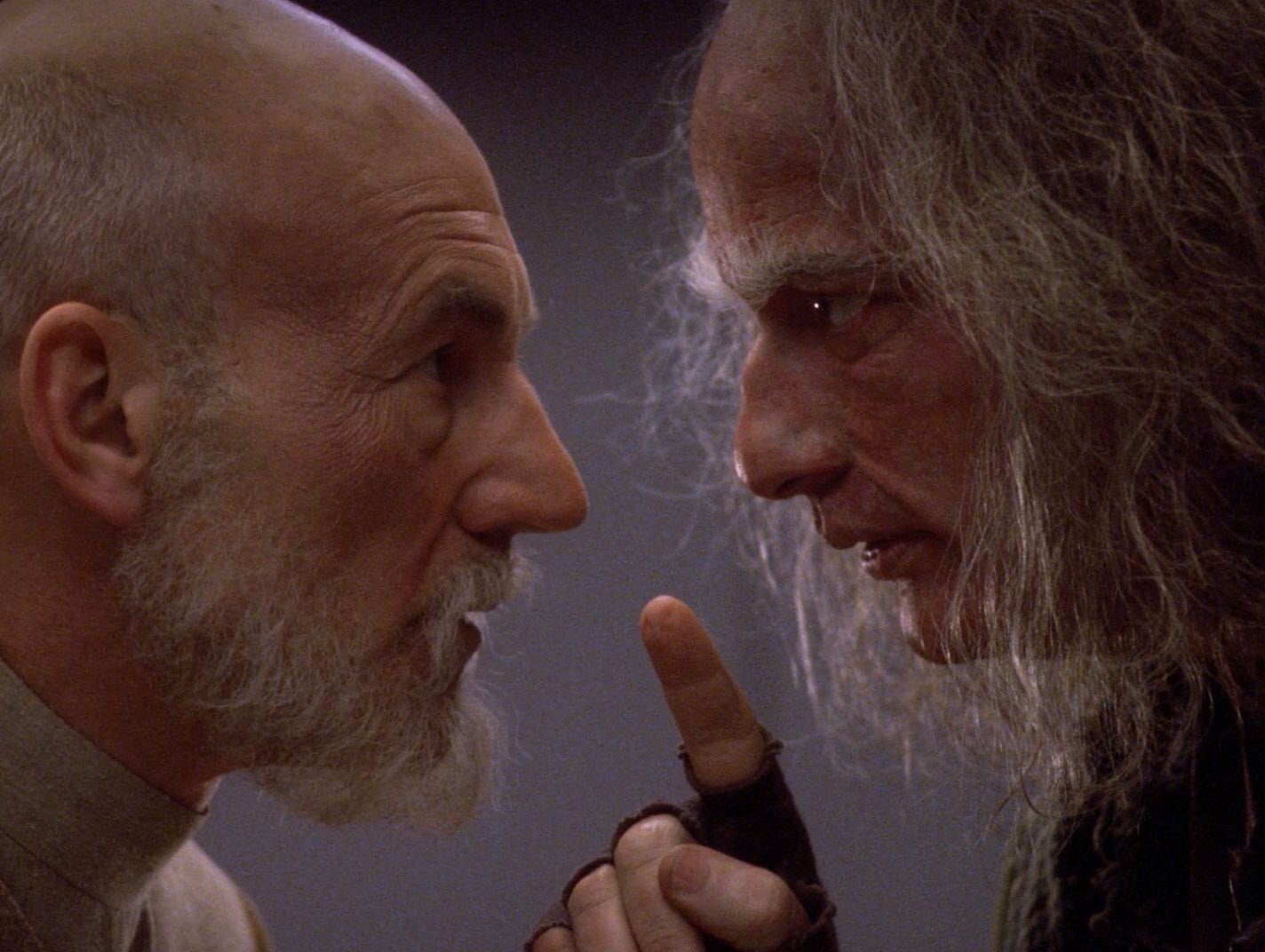
The Q plotline had been pitched by Ronald D. Moore earlier in the season, in a concept where Q had gone insane and was causing the universe to unravel. The crew would have found themselves in a bizarre world with a homeless man squatting in a corner next to a dustbin muttering “I used to be a superbeing... I used to be a superbeing” - before being revealed as John de Lancie’s Q. Michael Piller nixed this story, but he greenlit the idea of bringing in Q for the series finale.
Early drafts had quite different stops on the intertemporal expressway. The Borg attack at Wolf 359 was at one point a fourth major timeline, which would have featured Hugh helping to rescue Picard from the Borg. This fell by the wayside fairly swiftly, but with time running out to complete the screenplay, the story still had major problems in its second half (Acts 6 through 10). Michael Piller had to step in to help Braga and Moore step their game up:
The first draft of “All Good Things” was very similar for an hour, but the second hour wandered around without a clear story direction… I wanted Ron and Brannon to get more ambitious and suggested the idea of Picard working with different versions of himself in the different time periods to solve the crisis.
I have to note that there’s an alleged error in the screenplay. Data says: “It is as if all three originated from the Enterprise”. But it’s the Pasteur in the future, not the Enterprise, that fired the tachyon pulse. Of this, Moore later said:
This is an error that no one caught until the episode was on the air. And who caught it first? Rick Berman’s ten-year-old son. Kind of humbling.
To be fair, the Data who speaks this line has no idea that it isn’t an Enterprise in the future, so it’s not technically a mistake!
Braga has claimed this episode was the best Star Trek script he had ever written, which is obviously a mistake because “Frame of Mind” is clearly not only Braga’s best script, but the finest TNG episode bar none. But not to worry. Braga and Moore, in fact, were more pleased with “All Good Things...” than with Star Trek Generations - a point of view shared by the majority of fans, too. Rick Berman considered this one of his favourite episodes and “the best season-ender we ever did.”
What’s more, this episode won the 1995 Hugo Award for Best Dramatic Presentation, the second Hugo for TNG after season five’s “The Inner Light”.
Acting Roles
Obviously, the writers felt it was important to provide a framework that would allow Patrick Stewart to pull out a bravura performance as Captain Picard, and in this regard they ably succeed. But it would have been so much less fun if they hadn’t also got back John de Lancie as Q. It’s a joy to see the two of them in action again!
It’s also fun to get back Denise Crosby’s Natasha Yar (below left) and Colm Meaney as Miles O’Brien (below right), who of course hadn’t been out of Star Trek since he was a regular on DS9, but we hadn’t seen him on TNG for a year and a half.
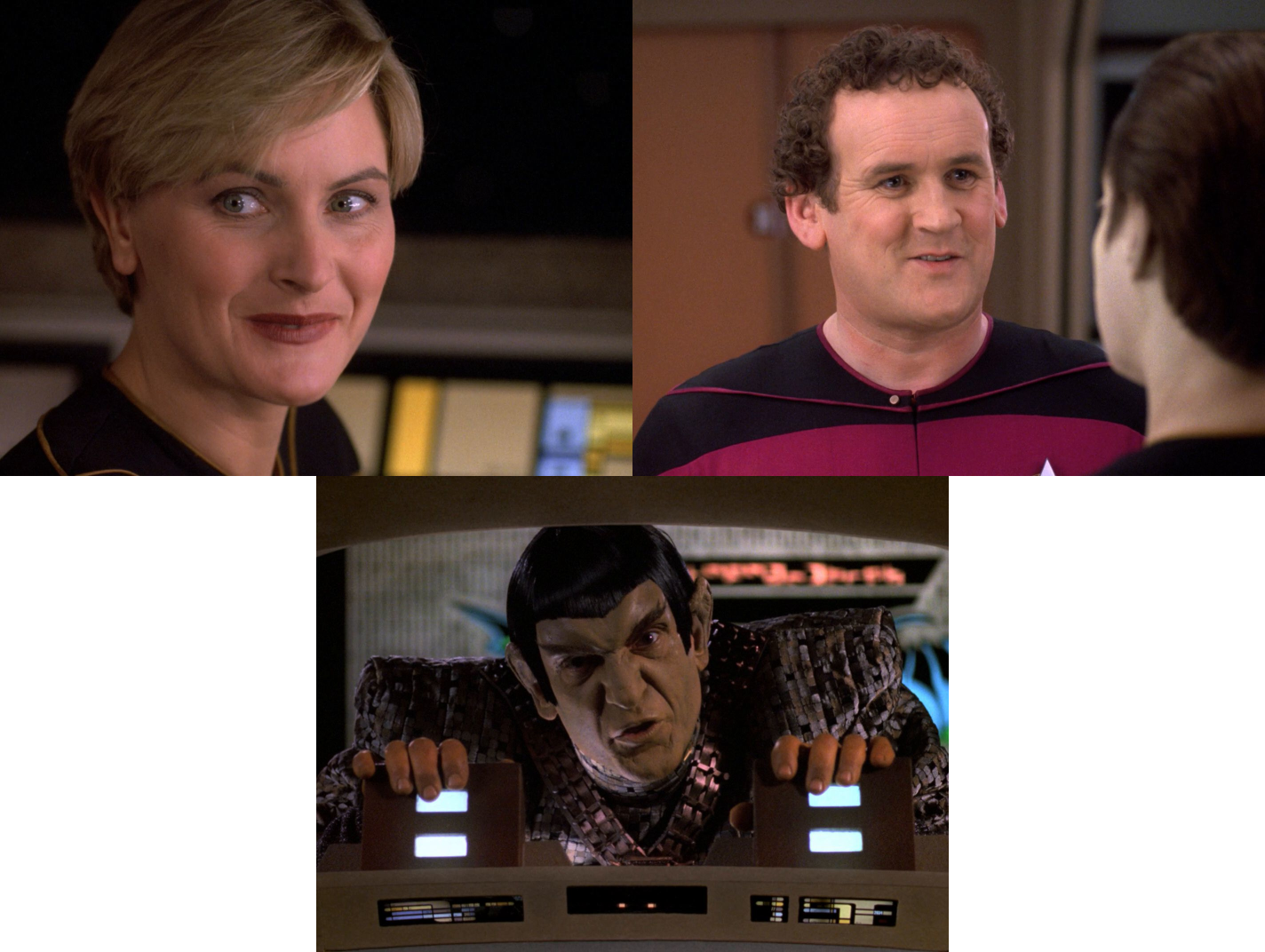
Meaney was thrilled to be involved:
It was strange, very nostalgic. I thought it was a very powerful way for ST:TNG to go out. I thought it was a great story and a terrific episode. It covered a lot of ground and left you thinking.
I particularly enjoy the return of Andreas Katsulas as Tomalak, who we hadn’t seen for three years (above bottom). Okay, he doesn’t have much to do here, but it’s still fun to see our Romulan baddie back on the viewscreen.
Everyone gets to play an older version of themselves!
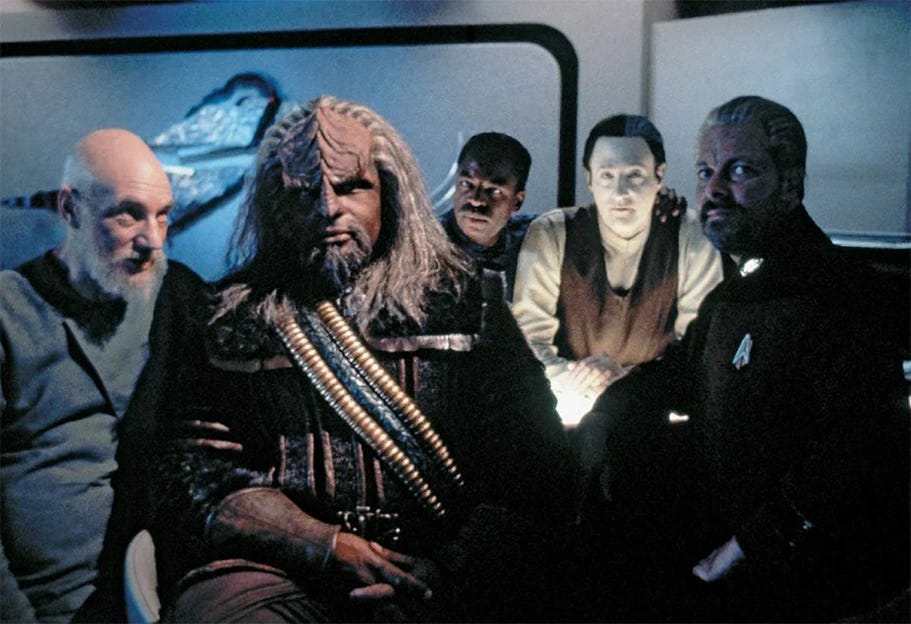
Well, everyone but Marina Sirtis, who is dead in the future. Still, she gets to appear in the past, since as with Denise Crosby, a well-chosen wig is enough to take off seven years! There’s a lot of fun with the aged versions of the characters, though, all of which constitute additional roles. Stewart’s Picard has to act dramatically befuddled, Brent Spiner’s future-Data gets to use contractions and idioms (an intentional contrast from ‘day one’ Data), LeVar Burton gets to go without his VISOR, Jonathan Frakes and Gates McFadden get to look older and more distinguished - but have some sympathy for poor Michael Dorn who had to sit in the make up chair to be made up in three different sets of make-up. What a trooper!
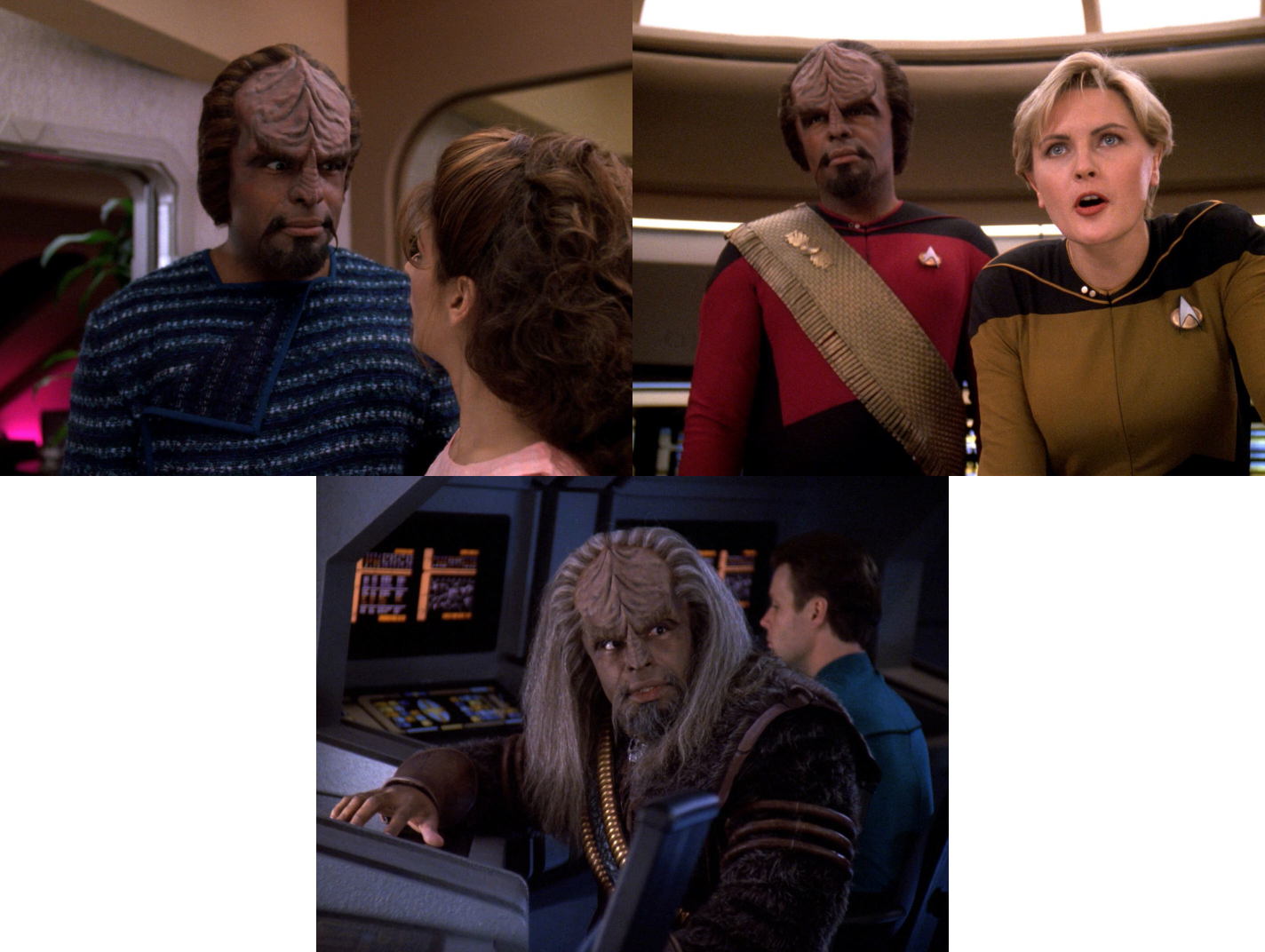
And speaking of Worf, how did he do this season? Well, he finishes up season seven 3-0 against the aliens - a meteoric victory, albeit in part because of the measly number of times they let him fight. Season two likewise had only three Worf fights, and he won that one 2-1. Overall, Worf finishes TNG 24-22. It’s official: despite his reputation for being beaten up by aliens, he finishes the show victorious! He also won as many seasons than he lost (losing seasons 1, 3, and 4, and tying in season 6), and much of his reputation as a wimp is probably based on season 1, which he lost 1-4. His other two losing seasons he was beaten by just one point. You heard it here first: Worf is a winner!
But there was no rest for the cast, as they only had a ten day break after the series wrap party before they started work on Star Trek Generations.
Models, Make-up, and Mattes
Picard’s future vineyard was shot at Callaway Vineyard & Winery in Temecula, which is a whopping hundred miles from Paramount Studios - a two hour drive in Los Angeles traffic. This is the furthest the team travelled for a location shoot at any point in TNG.
The make-up team were kept busy with Worf’s triple appearances (see above), Tomalak’s Romulan latex, and making everyone look older. But they couldn’t make Jonathan Frakes look as hilariously young as he did in “Encounter at Farpoint” - so they reused footage from season one’s “The Arsenal of Freedom”.
The sets team were also forced to work their butts off, as they had to modify the Enterprise materiel to make it look like they did in season one, and to make everything look futuristic for the trip later down the timeline. One of the toughest part of this was restoring the wood panelling to the equipment lockers either side of the bridge - not to mention the golden ship models in the observation lounge, which had not been seen for years. Meanwhile, the bridge of the USS Pasteur is a redress of the mercenary ship in “Gambit”.
But you probably didn’t notice all the incredibly difficult work on the sets, because you were dazzled with a great set of action sequences as the USS Pasteur (new studio miniature!) is attacked by Klingon attack cruisers (also new studio miniatures!)...
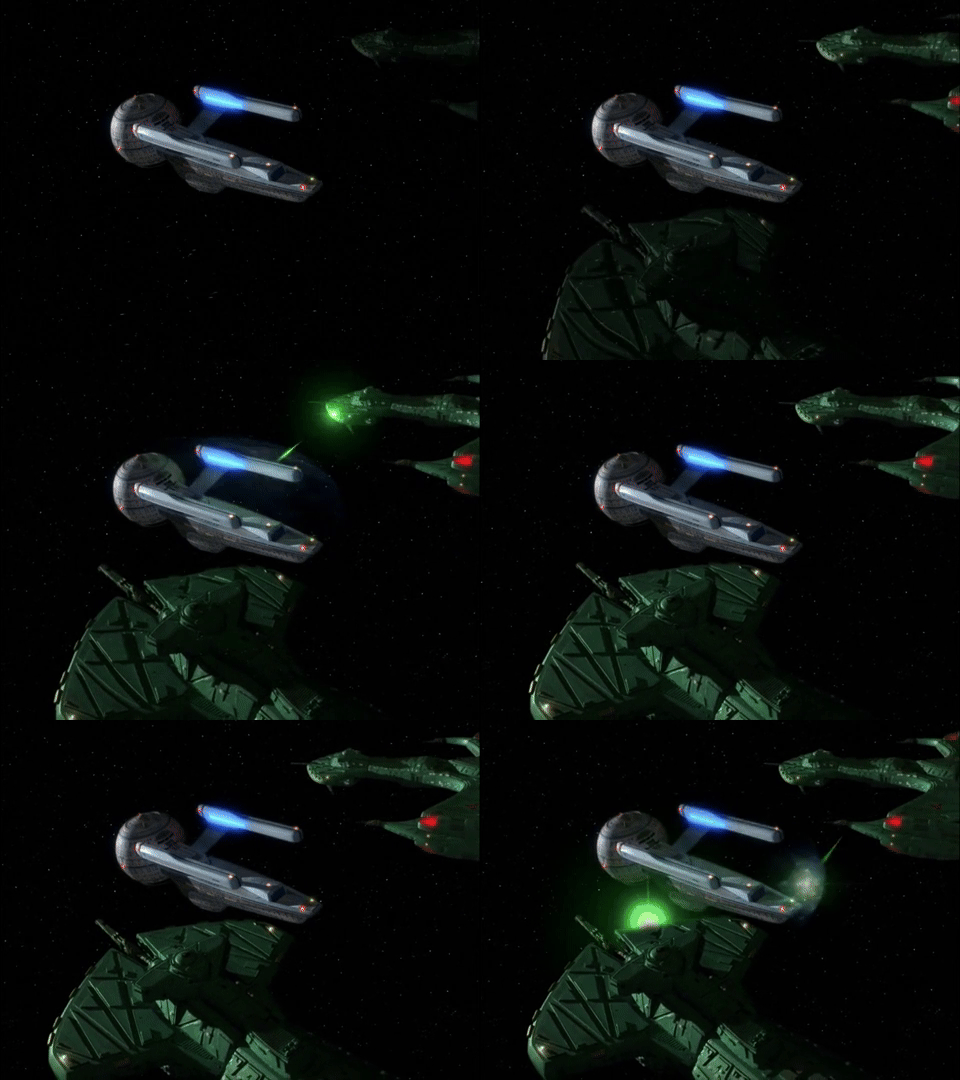
...followed by Riker’s Enterprise-D getting to blow one up!
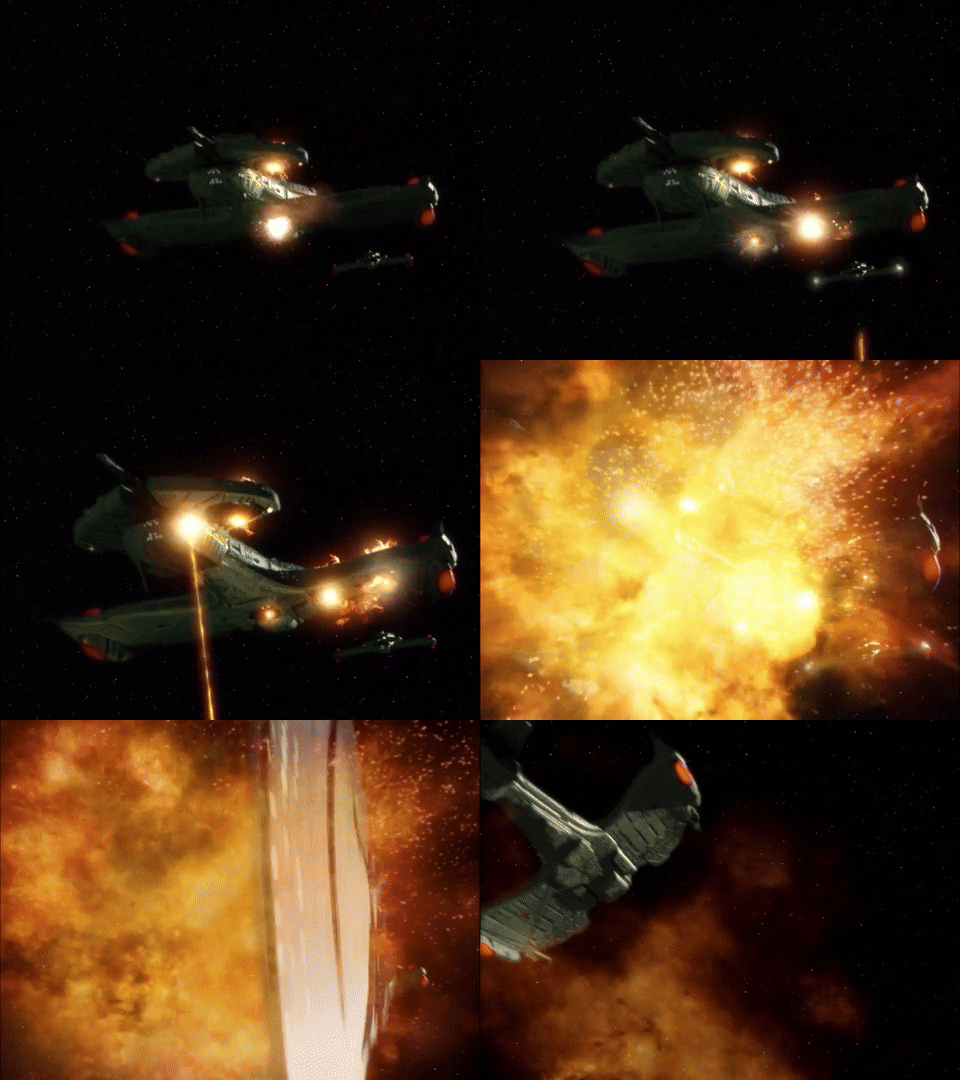
That’s three new studio miniatures in this sequence, including the modified Enterprise-D with its silly third nacelle and ‘go faster’ stripes.
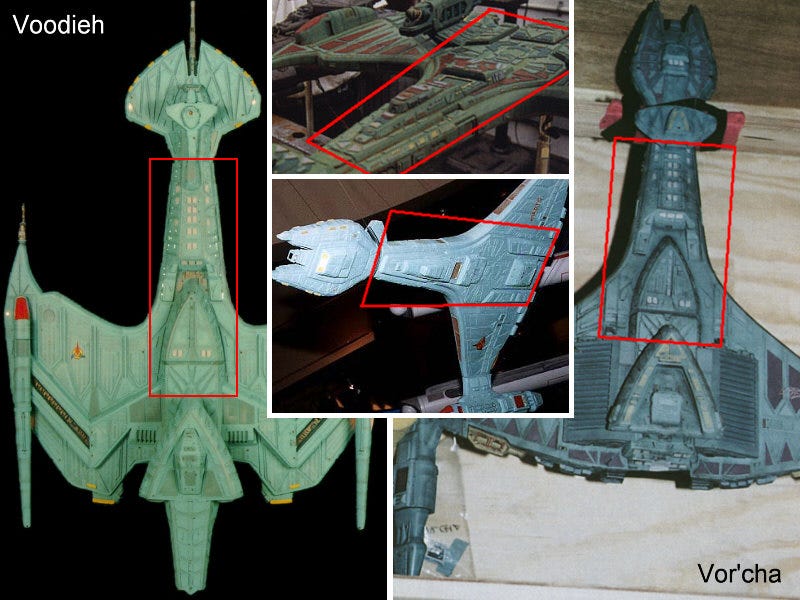
Those wonderful folks at Ex Astris Scientia, to whom I’m enormously indebted for many subtle points about the models and matte paintings over the course of TNG, have shown how the Klingon ships in this episode (later dubbed ‘Voodieh class’) were put together using components from the casting of the attack cruiser studio miniature introduced in season four’s “Reunion” (and eventually called ‘Vor’cha class’). Take a look!
And just to make sure everyone is satisfied (even me!) there’s not one but two brilliant matte painting shots! An exterior shot of Data’s digs at Cambridge University (below left, which looks like a real mess in the 24th century!), and the primordial planet Earth where Q brings Picard on a joy ride (below right).
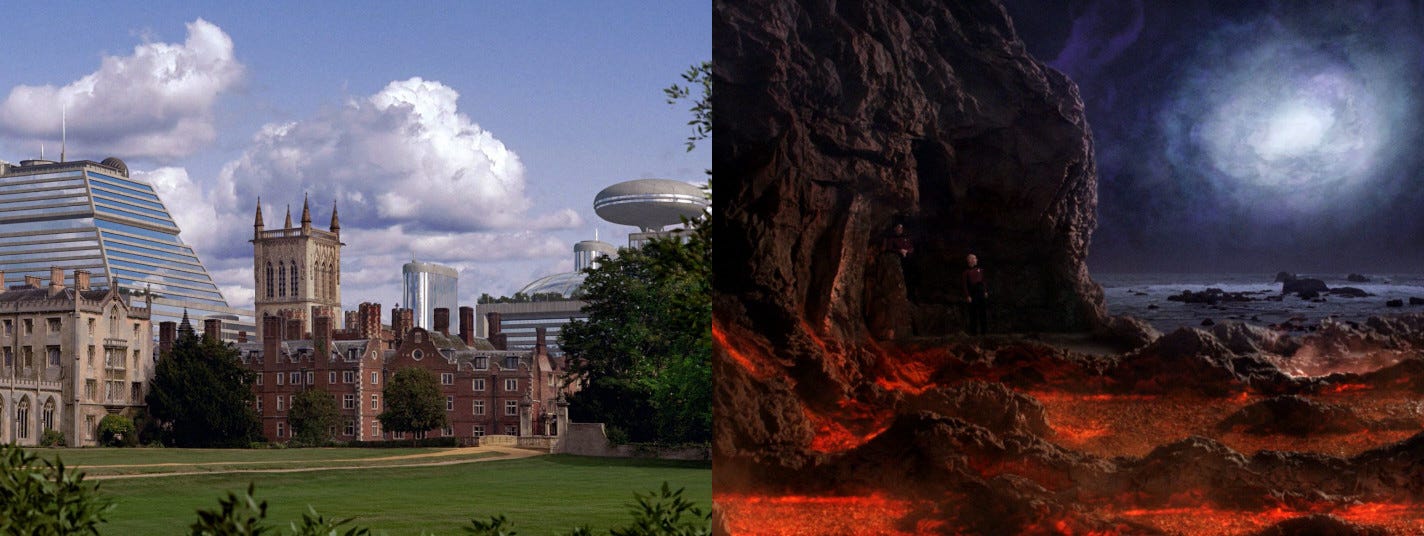
Everyone in the SFX teams worked their asses off - and it all paid off. This episode was nominated for four Emmies - and it won for Outstanding Individual Achievement in Special Visual Effects.
“All Good Things...” is a classic, everybody loves it, and whatever aspects of this episode don’t reach up to the glorious heights of the greatest TNG episodes are more than compensated for by the sheer fan service on display. It’s a greatest hits of TNG acting talent, a masterpiece in lazy ‘shipping’ (putting together both Picard and Crusher and hinting at a restoration of the romance between Riker and Troi), and another classic time loop episode from Braga to boot (and yes, of course, he blew up the Enterprise as well - twice!). It has everything - and the runtime to go with it! It is indeed a showcase of ‘all good things’ about Star Trek: The Next Generation, and a fitting finale to one of Star Trek‘s greatest ever TV shows.
And that’s the End of WAMTNG…
…unless you vote for it to continue!

Not surprisingly, I do remember _this_ S7 episode, and loving it.
I’ve watched it again since, of course, but not for a while: I remember being less impressed when I rewatched it the last time around. I don’t really recall why, though: I should give it another run.
The Enterprise-D coming up from “below” (hey look, three dimensions, who knew?!) and shooting up the Klingon ship, though: excellent ship shot.
— Formerly Ensign inw.